The “Burial Ground for Negroes,” as it was titled on a map of the city in 1809, was the first designated burial spot for the city’s enslaved and free residents of African ancestry. Its origins are not documented, but it came into use in relation to the whites-only burial ground around St. John’s church sometime in the eighteenth century. The burial ground may have begun as late as 1799, when the city purchased an irregularly-shaped lot from Philip Turpin on the eastern flank of Shockoe Hill descending down to Shockoe Creek. It sat roughly north of the modern intersection of 15th and Broad Streets and Interstate 95, and judging from its label on the early map, it appears to have encompassed at least 1.5 acres of ground.
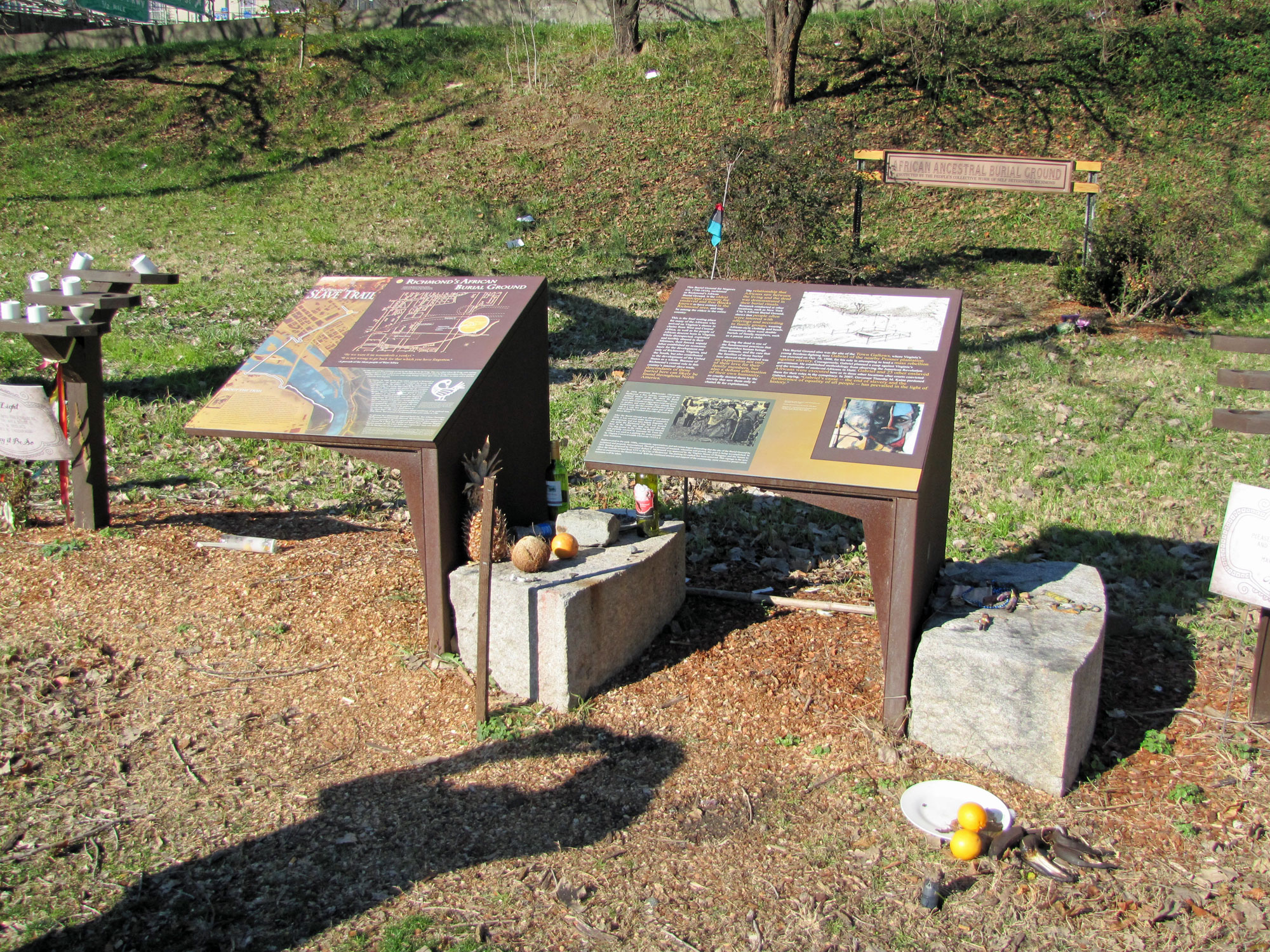
This was poor quality land, and by 1806 it was also the site of the city gallows where convicts were publicly hung. The city’s powder magazine stood nearby. Any memorials or markers left by survivors have disintegrated with time, or they are covered by many feet of later fill and construction.
Richmond’s black residents vigorously protested the conditions at this “Gallows ground,” or “mock of a grave yard.” When the city delayed, free black residents organized in 1815 to purchase land for a new burial ground on the north side of town. Their private site would become known as the Barton Heights cemeteries. The following year, in 1816, the city opened a burial site consisting of “one acre for the free people of colour, and one for slaves in the City” to the northwest on Shockoe Hill. This effectively closed Shockoe Bottom’s “Burial Ground for Negroes” to further burials. The city then built a schoolhouse for the children of poor whites on the old site and later a jail, as development continued. Shockoe Creek was diverted east and eventually routed underground. After more decades of infill, the construction of the Richmond-Petersburg Turnpike (soon to be incorporated into Interstate 95) in 1958 devastated the property.
Attention to the site was renewed in the 1990s, through the work of local historian Elizabeth Kambourian, who “rediscovered” the burial ground on historic maps. Groups of activists, including the Defenders for Freedom, Justice & Equality, and the Slave Trail Commission of the Richmond City Council, then began working to recognize the site and properly commemorate it. Amid the controversy, the state Department of Historic Resources undertook a study in 2008 which concluded that a portion of the original burial ground may have extended beyond Interstate 95 to an adjoining parking lot, then owned by Virginia Commonwealth University. In 2011, Governor Bob McDonnell made state funds available to purchase the 3.4-acre lot from VCU and transfer the historic property to the City of Richmond. After the parking lot was removed, activists placed artwork and signage there and rechristened it the “African Burial Ground.”
Proposals for a new baseball stadium and commercial complex adjoining this land in Shockoe Bottom were repeatedly raised and defeated, most recently in 2014. In the midst of protests against these proposals, the Defenders for Freedom, Justice & Equality led a series of community conversations to develop an alternative vision for the Bottom, given its place as the center of the city’s nineteenth-century slave trade. The city government pivoted to pursue parallel commemoration plans, and in 2016, Mayor Dwight Jones announced that planning firms had been commissioned to begin this work starting with the old Lumpkin’s slave jail site across Broad Street from the burial ground.
In 2018, Jones’s successor Mayor Levar Stoney participated in the Rose Center for Public Leadership’s fellowship program which brought renewed momentum for a wider planning process in Shockoe Bottom. In 2019, Stoney announced the formation of the Shockoe Alliance, attempting to bring together the various stakeholders to develop a shared vision for the historic area.
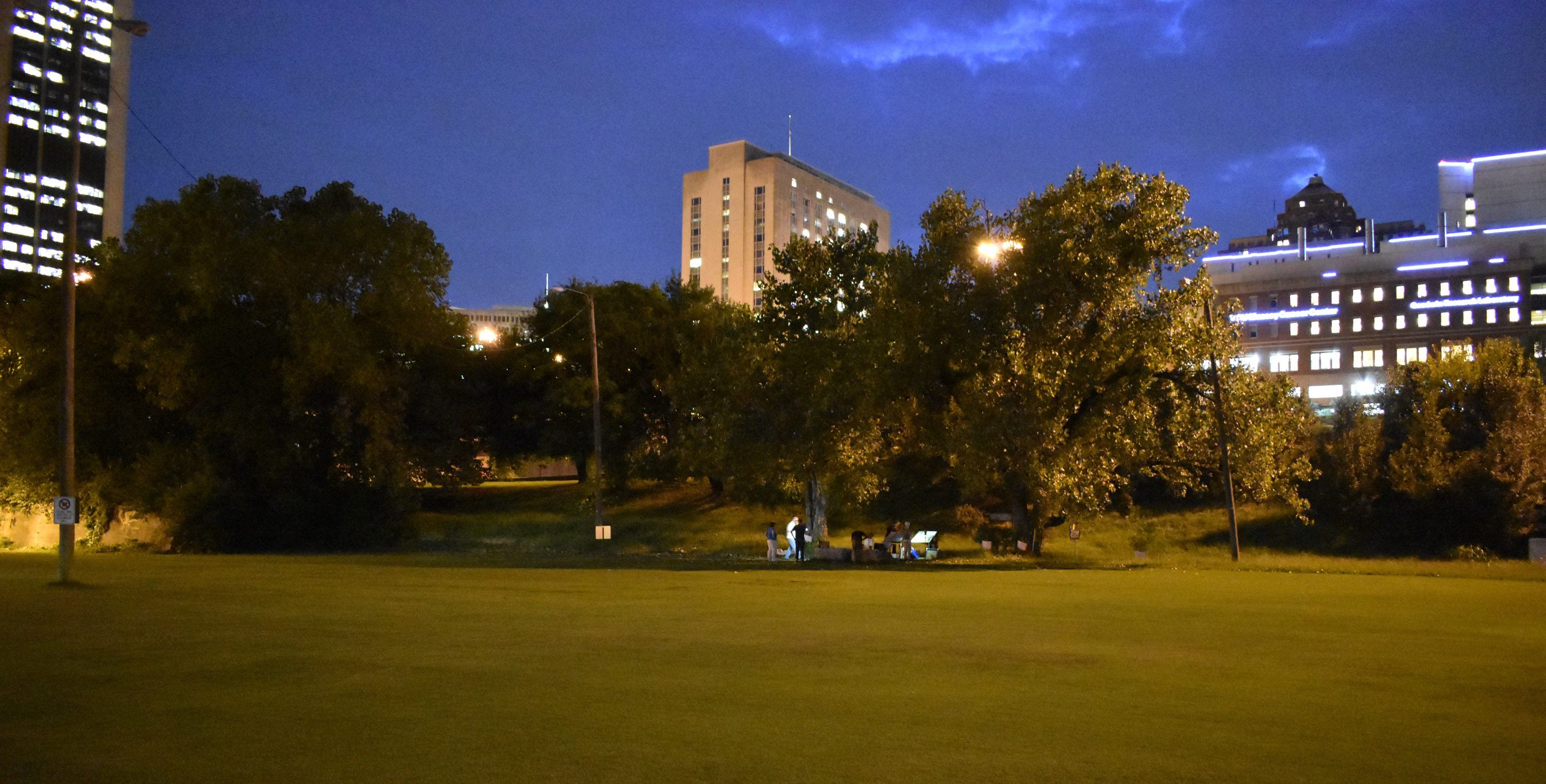 Today the burial ground remains something of an “in-between” space, resting as an important spot on the city’s historical Slave Trail yet also awaiting the outcome of big plans for the area.
Podcast for Nanny (wife of Prosser’s Gabriel), who died sometime in the early nineteenth century and whose burial site is unknown, by Crystal Couser, Jennifer Galicia, and Amira Kamara:
For more information, see:
The Defenders’ Sacred Ground Historical Reclamation Project
Shawn Utsey, “Meet Me in the Bottom: The Struggle to Reclaim Richmond’s African Burial Ground,” documentary film, 2009
Veronica Davis, Here I Lay My Burdens Down: A History of the Black Cemeteries of Richmond, Virginia (Richmond: Dietz Press, 2000)
Department of Historic Resources, Virginia, “Burial Ground for Negroes, Richmond, Virginia: Validation and Assessment,” by Christopher M. Stevenson, June 2008.
Jeffrey Ruggles, “The Burial Ground: An Early African-American Site in Richmond: Notes on its History and Location,” 2009
Bryan Clark Green and Matthew R. Laird, “The ‘Burial Ground for Negroes’ Site, City of Richmond, Virginia: An Historical and Archaeological Analysis,” unpublished paper, 2012
Mai-Linh K. Hong, “‘Get Your Asphalt Off My Ancestors!’: Reclaiming Richmond’s African Burial Ground,” Law, Culture and the Humanities, 2013
Autumn Rain Duke Barrett, “Honoring the Ancestors: Historical Reclamation and Self-Determined Identities in Richmond and Rio de Janeiro,” PhD diss., College of William and Mary, 2014
Gibson Worsham, “The Location of Richmond’s First African-American Burial Ground,” 2015
Ellen L. Chapman, “Buried Beneath the River City: Investigating an Archaeological Landscape and its Community Value in Richmond, Virginia,” Ph.D. diss., College of William & Mary, 2018